A Gulf ad can look perfect and still lose the viewer in the first second the voice speaks. Arabic audiences notice a wrong accent, a flat rhythm or a mangled brand name instantly. Choosing the right Arabic AI voice over for ads is less about the tool and more about who is listening, where, and what you are selling.
Dialect or Modern Standard Arabic: The First Decision
Arabic is not one spoken voice. Gulf Arabic is a colloquial variety spoken across Kuwait, Qatar, the UAE, Oman, Bahrain and parts of Saudi Arabia, while Modern Standard Arabic (MSA) is the shared written form used in media, government and religion. Many Gulf speakers move naturally between the two.
For ads, that gives you two very different tools:
— Khaleeji dialect (Saudi, Emirati, Qatari): feels personal, local and conversational. It suits UGC testimonials, street interviews, unboxing videos and anything meant to sound like a real customer.
— Modern Standard Arabic: feels formal, trusted and pan-Arab. It suits launches, institutional messages, education and campaigns running across several Arab markets at once.
The dialects inside the Gulf are not interchangeable either. A Riyadh shopper hears the difference between a Saudi and an Emirati voice, and a Qatari audience notices when a "local" ad clearly is not.
When Each Choice Fits
Think in three layers: product, platform and audience.
Product. Oud, bakhoor and abaya brands often win with a warm Khaleeji voice, because the purchase is emotional and rooted in local taste. A school, a government-linked initiative or a premium launch film often reads better in MSA.
Platform. TikTok and Snapchat reward voices that sound like people talking to a friend, so dialect usually performs more naturally there. YouTube pre-roll, cinema and TV-style spots can carry the weight of MSA.
Audience. If one ad must run in Saudi Arabia, the UAE and Qatar together, MSA avoids picking a side. If you can afford one version per market, a dialect cut per country feels closer to home.
What Makes an Arabic AI Voice Sound Natural
Leading tools now cover Gulf locales. Microsoft's Azure Speech service, for example, lists separate text to speech voices for Saudi (ar-SA), Emirati (ar-AE) and Qatari (ar-QA) Arabic, and ElevenLabs says its Arabic voices can adapt to regional accents. Coverage is not the same as quality, though. What separates natural from uncanny:
— Pronunciation. Dialect sounds, like the Gulf "g" for qaf or "y" for jeem in some words, must be consistent. A voice that switches mid-sentence sounds synthetic.
— Rhythm and stress. Arabic sentences have their own music. Flat pacing, wrong pauses or stress on the wrong syllable give the AI away fast.
— Diacritics in the script. Unvowelled text lets the model guess. Adding key tashkeel on ambiguous words removes most mispronunciations.
— Code-switching with English brand names. Gulf speakers say "TikTok", "Snapchat" or a product name in English inside Arabic sentences. The voice must switch cleanly and switch back, without an English accent bleeding into the Arabic.
Lip-Sync Has Limits
AI lip-sync in Arabic is improving, but it is still weaker than in English, especially for fast dialect speech and close-ups. Mouth shapes for emphatic consonants and long vowels are where it breaks.
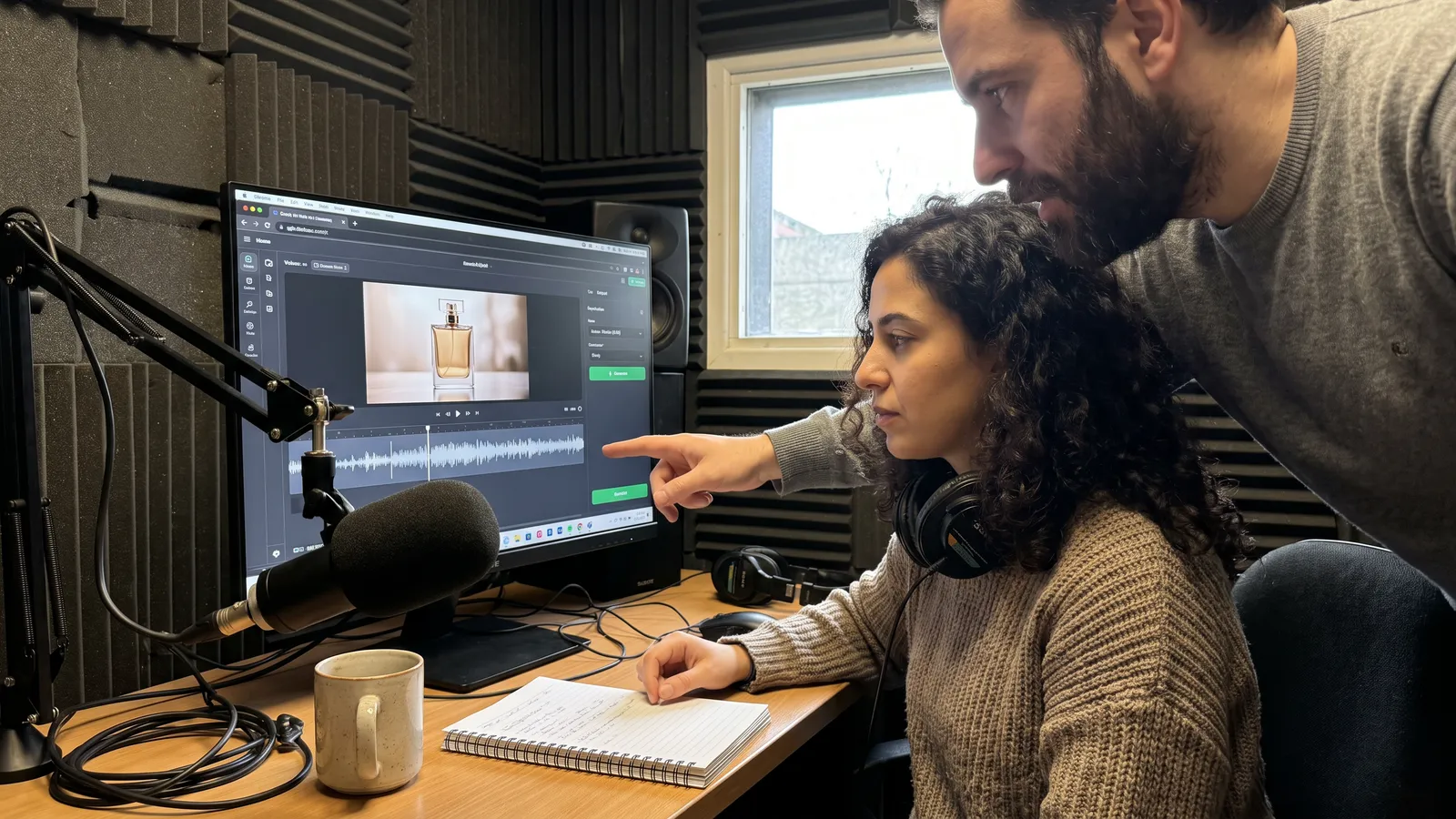
Sawa's rule is simple: if Arabic lip-sync fails the review, the scene becomes a voice-over or B-roll version instead. Product shots, hands, textures and lifestyle footage carry the story while the voice speaks. Uncanny Arabic never ships, because a viewer who notices a mismatched mouth stops trusting the brand.
Disclose, Always
An AI voice should never pretend to be a real customer or a real person. Platforms are moving the same way: Meta adds "AI info" labels when it detects industry-standard AI signals or when people disclose that content is AI-generated. Sawa labels its AI work openly, and honest disclosure costs nothing when the ad is well made.
FAQ
Should my Gulf ad use Khaleeji dialect or Modern Standard Arabic?
Use Khaleeji for personal, social-first formats like UGC and testimonials aimed at one country. Use MSA for formal messages, education or one ad running across several Arab markets.
Can AI voices speak Saudi, Emirati and Qatari Arabic?
Yes. Major tools such as Microsoft Azure Speech list dedicated Saudi, Emirati and Qatari voices, and ElevenLabs supports regional Arabic accents. A human director still needs to check pronunciation and rhythm.
What happens if Arabic lip-sync looks wrong?
The scene should switch to voice-over or B-roll. A clean voice over product and lifestyle footage always beats a mouth that does not match the words.
Sources
Language and voice support for the Speech service (Microsoft Learn) (opens in a new tab)
Arabic Text to Speech (ElevenLabs) (opens in a new tab)
Gulf Arabic (Wikipedia) (opens in a new tab)
Our Approach to Labeling AI-Generated Content and Manipulated Media (Meta) (opens in a new tab)