ASMR video ads sell through sound and close detail: the click of a lid, a cream spread on skin, fabric brushing past the microphone. Done well, they make a viewer stop scrolling and feel the product before they own it. Done badly, they annoy people. This guide explains what ASMR video ads are, which Gulf products suit them, how to film and edit them, what the research says about who responds, and the mistakes to avoid.
What Are ASMR Video Ads?
ASMR video ads use quiet, close, satisfying sounds and slow detailed pictures to create a calm, pleasant feeling around a product. ASMR stands for autonomous sensory meridian response, the tingling or relaxed feeling some people get from certain sounds and attention.
In practice, an ASMR ad usually has:
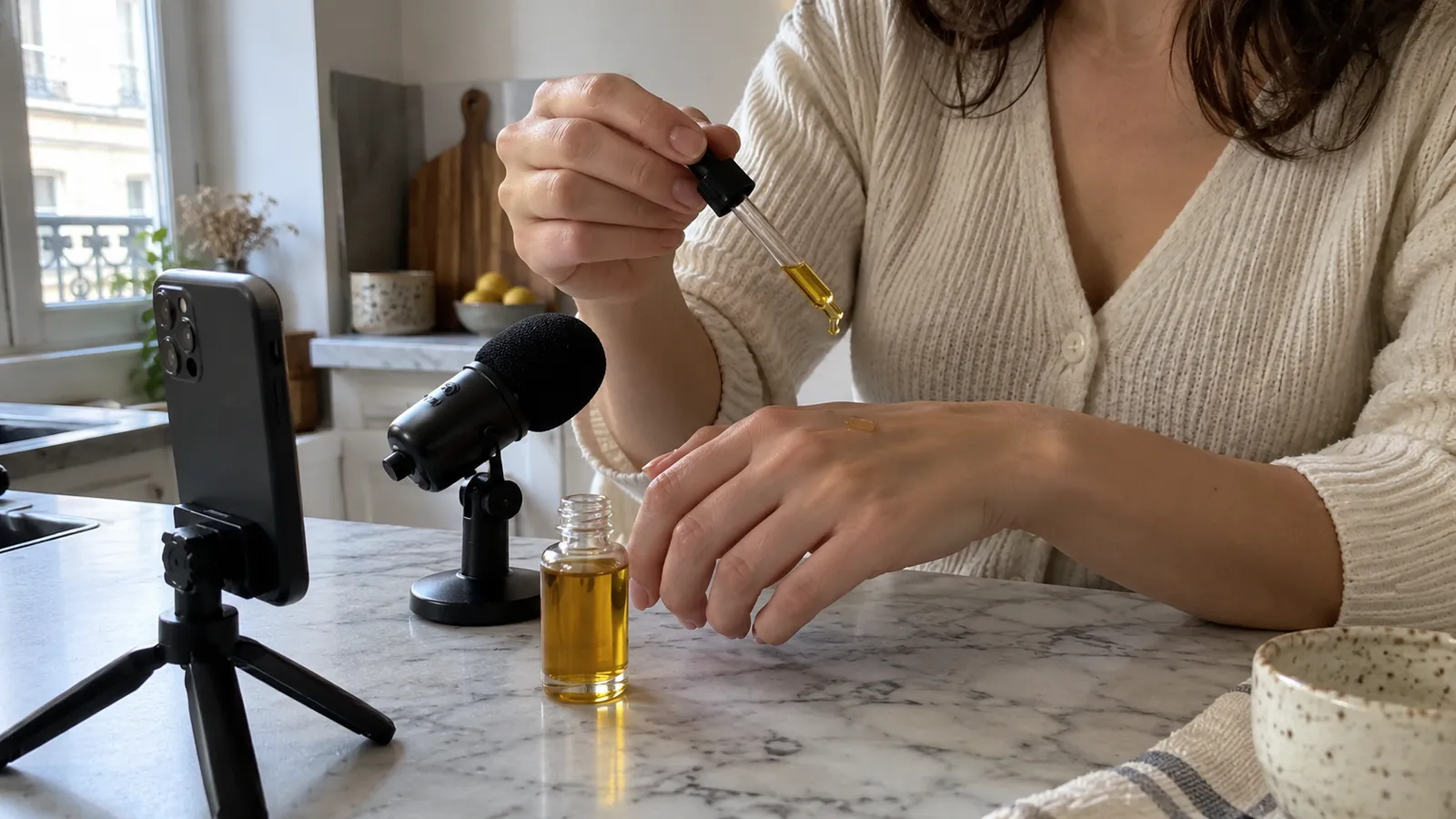
- Close sound. A microphone near the product picks up taps, pours, crinkles and whispers.
- Close pictures. Macro shots of texture: a drop of oil, a cream swirl, a stitch in fabric.
- Slow pace. Few cuts and no rush to the logo.
- Little or no voice. If there is speech, it is soft and personal.
Glossy described beauty brands such as Milk Makeup, Huda Beauty, Tarte and Glow Recipe posting ASMR videos on TikTok: cream spread on a hand, brushes clicking, nails tapping on containers. Researcher Craig Richard told Glossy that the more human and natural the production is, the more likely it is to stimulate ASMR.
Which Products Suit ASMR Video Ads?
Products with a texture, a sound or a ritual suit ASMR best. For Gulf brands, four categories stand out:
- Fragrance and oud. A cap twisting off, a spray, coal crackling under bakhoor. Our guide to oud video ads covers how to film smoke.
- Skincare. A pump, a serum drop, a cream pressed between fingers. Texture is the proof.
- Abayas and fabric. Silk sliding over a hand, a zip, a box of folded fabric opening.
- Food and sweets. Crunch, pour, a knife through layers of a cake.
Products with nothing to touch or hear, like a software subscription, rarely suit the style.
Does ASMR Advertising Actually Work?
It works for some viewers and puts others off, so test it rather than assume it. A 2024 study in the Journal of Retailing and Consumer Services found a generally negative effect of ASMR on ad attitudes across the wider population, but a positive effect among people who actually feel ASMR's physical sensations. The same study found negative brand attitudes only for unknown brands.
What that means for a Gulf brand:
- Known brands have more room. If people already know you, ASMR is lower risk.
- New brands should mix it. Put ASMR moments inside a UGC or unboxing ad rather than running pure ASMR alone.
- Target the response. Treat ASMR as one variation in a test, and read the results for your audience.
How Do You Film an ASMR Video Ad?
Film close, quiet and slow, and record sound as carefully as the picture. Five steps cover most shoots:
- Pick a quiet room. Turn off the air conditioning for each take if you can, because its hum ruins close audio.
- Get the microphone close. A small microphone just out of frame, near the product, beats any built-in phone mic at a distance.
- Use soft side light. Light from a window or a soft lamp to one side shows texture.
- Shoot in 9:16 at close range. TikTok's creative best practices say to film at 9:16 and shoot at least 720p.
- Do several takes of each sound. The best tap or pour is rarely the first.
How Should You Edit ASMR Ads for Each Platform?
Lead with the most satisfying sound and picture, keep the volume gentle, and make the ad work on mute too.
- TikTok. Introduce your proposition in the first 3 seconds and prioritise the hook in the first 6, as TikTok's creative best practices advise. Open on the sound, not on the logo.
- Instagram Reels. Meta's developer blog lists ASMR among the audio it suggests for Reels ads and says over 75% of Reels views on Instagram are sound on.
- Snapchat. It advises a message that stays clear without sound, so the pictures must carry the product even when muted. Add a short caption.
Volume matters. YouGov noted that ASMR creators have urged brands to lower their ad volume, because loud ads disrupt the viewing experience. Mix the ad quieter than your other spots and avoid sudden loud music at the end.
A Walked-Through Example
Say you sell a body oil in Abu Dhabi, mostly through Instagram and TikTok. This is an example of the method, not a real client.
- Goal. Show the texture and make people want to try it.
- Sounds. The glass dropper, oil falling onto the back of a hand, skin pressed gently, the bottle set down on marble.
- Shots. Four close shots in soft window light, no face for the first 5 seconds.
- Structure. 15 seconds: dropper and drop (0 to 4), spreading (4 to 10), the bottle and name (10 to 15).
- Caption. One Arabic line at the end, «نعومة تُحَس», and the product name.
- Test. Run it against your best UGC testimonial, and a third version that puts the ASMR opening in front of the testimonial.
Checklist Before You Launch
- A product with texture or sound.
- Clean close audio, no air conditioning hum.
- Strongest sound in the first 3 seconds.
- Gentle volume, no loud ending.
- Works on mute with one short caption.
- AI disclosure on, if any part is generated or significantly modified by AI.
Common Mistakes in ASMR Ads
- Music on top. Glossy notes that background music typically does not trigger ASMR. Let the product sound carry the ad.
- Too loud. A shouting voiceover or a loud ending breaks the calm and annoys viewers.
- Generic sounds. Stock tapping that has nothing to do with your product says nothing about it.
- Too many cuts. Fast editing fights the slow, calm feeling.
- Using it everywhere. ASMR is one style in your mix, not every ad. Our guide to unboxing video ads shows a style that pairs well with it.
At Sawa Films a director oversees every version and we always disclose AI. A quiet ad can be the one that gets heard.
FAQ
What does ASMR mean in advertising?
ASMR stands for autonomous sensory meridian response. In advertising it means ads built on quiet, close, satisfying sounds and slow detailed pictures that give viewers a calm, pleasant feeling around a product.
Do ASMR ads work for every brand?
No. A 2024 study found ASMR ads helped among people who feel ASMR but hurt attitudes in the wider audience, and hurt brand attitudes only for unknown brands. Test it as one variation.
How long should an ASMR video ad be?
Short. Around 15 seconds is enough to show one ritual, as long as the most satisfying sound comes in the first 3 seconds, which TikTok's creative guidance recommends for the proposition.
Sources
ASMR takes over beauty brands' TikTok accounts (Glossy) (opens in a new tab)
Brands need to fine-tune their approach when advertising with ASMR (YouGov) (opens in a new tab)
Creative best practices for performance ads (TikTok Ads Help Center) (opens in a new tab)
Unlock the Power of Reels Ads (Meta for Developers) (opens in a new tab)
Making Better Videos for Snapchat Ads (Snapchat for Business) (opens in a new tab)