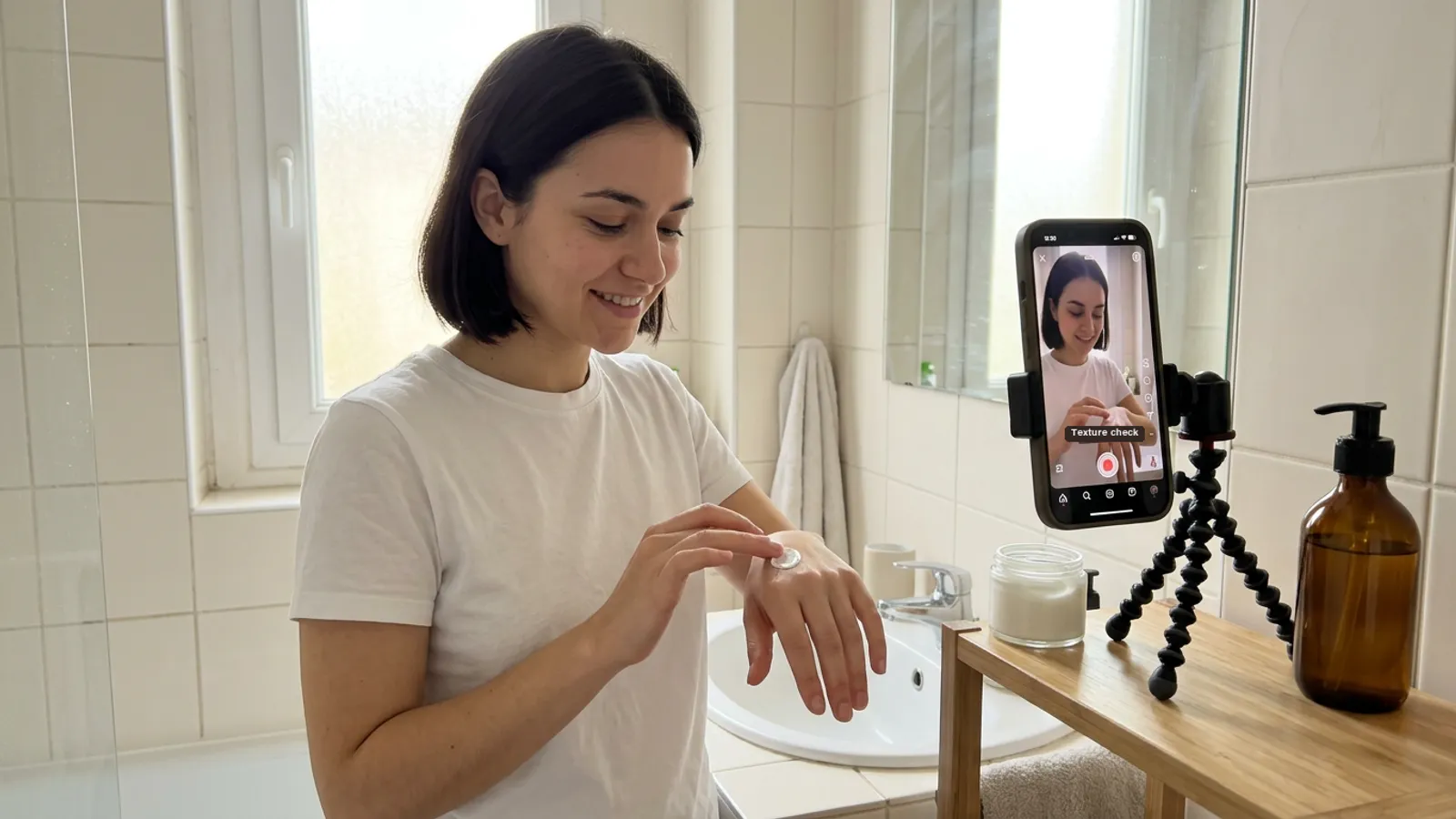
UGC ads are paid video ads that look like a post from a real customer: someone talking to their phone, opening a parcel or showing how they use a product at home. UGC stands for user generated content. So if you are asking what are UGC ads, the short answer is ordinary looking, phone style video that a brand runs as an ad on TikTok, Snapchat and Instagram Reels.
What Are UGC Ads & What Does UGC Mean?
UGC is content made by people rather than by the brand: a review, a photo, a short video. In advertising, it also covers content brands commission from creators to feel like a customer post.
Shopify defines UGC ads as ads that "use real customer or creator content to promote a product in an authentic, relatable way." Two things turn a post into a UGC ad:
- It runs as a paid ad from the brand's ad account, with targeting and a call to action.
- The brand has the right to use it. Shopify advises asking customers for permission in writing and agreeing the platforms, formats and duration.
UGC Ads vs Influencer Posts vs Commercials
A UGC ad sells through a person's experience, an influencer post through a person's audience, and a commercial through craft and brand image.
Influencer posts live on the creator's account and reach their followers. On TikTok, a brand can boost a creator's post as a Spark Ad with the creator's authorization, and the engagement is attributed to the original post. In Saudi Arabia, Gulf News reported in December 2024 that influencers, including visiting ones, must hold the Mawthooq licence from the General Authority for Media Regulation.
UGC ads do not depend on followers: Shopify says UGC is about content quality rather than reach. They run from your own account, so you can test many versions.
Commercials use lighting, sets and a script to build a brand image. In a short video feed, TikTok advises "a DIY or not overly polished style" that fits in with the UGC around it.
Types of UGC Ads: 8 Common Formats
Common UGC ad formats include testimonials, reviews, unboxings, street interviews and demos.
- Testimonial. A customer tells the camera what changed for them.
- Product Review. A creator weighs what they liked and what to know before buying.
- Unboxing. The parcel opened on camera and the product revealed.
- Street Interview. A host asks passers by a question, and the product is the answer.
- Demo or Routine. The product in use, step by step, like a morning skincare routine.
- Problem & Solution. A familiar annoyance first, then the fix.
- Day in the Life. The product inside an ordinary day, like the school run.
- ASMR Sensory. Close sound and texture: a cap clicking shut, a cream spreading.
Where UGC Ads Run in the Gulf
UGC ads run on TikTok, Snapchat and Instagram Reels, the full screen vertical feeds where Gulf audiences already scroll. DataReportal's Digital 2026 reports, based on the platforms' own ad tools, put Snapchat's ad reach at the equivalent of 72.9% of Saudi Arabia's population at the end of 2025, Instagram's at 70.5% of the UAE's population, and TikTok's at 95.2% of internet users in Qatar.
Each platform's advice fits the format:
- TikTok recommends "featuring people such as creators, employees, or customers", a hook in the first 6 seconds, and 3 to 5 different creatives per ad group.
- Snapchat says it is built for full screen vertical viewing, that many users watch with the sound off, and that ads should pack a punch in the first few seconds.
- Instagram Reels. Meta says 79% of people surveyed say they have bought a product or service after watching Reels, and that campaigns with 9:16 video, audio and key messages in the safe zone saw 2x higher delivery to Reels.
How AI UGC Ads Work
An AI UGC ad keeps the phone style format but replaces the shoot with an AI generated presenter, voice and scenes, built around your real product:
- Brief. One product, one audience, one message, one dialect.
- Script & Hook. Written for the first 6 seconds, in Khaleeji, MSA or English.
- Presenter. An AI character kept consistent across versions.
- Product. Built from your real product photos, so the packaging matches what customers receive.
- Edit. A director cuts a version per platform, with captions for viewers on mute.
- Label. The AI disclosure goes on before launch.
One rule matters most: an AI presenter has never used your product, so it must not pose as a real customer giving a testimonial. Use it to present and demonstrate. At Sawa Films a director oversees every AI ad, and we always disclose AI.
AI Disclosure Rules on Meta & TikTok
TikTok requires advertisers to disclose AI content in ads, and Meta labels AI made ad images itself, so an AI UGC ad should carry a label every time.
- TikTok Ads. When an ad's image, video or audio is completely AI generated or significantly modified by AI, TikTok Ads Manager has a toggle: "This ad contains AI-generated content". A clear disclaimer, caption or watermark also counts, and ads with undisclosed AI content are rejected or restricted.
- TikTok Spark Ads follow the Community Guidelines, which require creators to label realistic AI content. TikTok says the label won't affect distribution for posts that follow its guidelines, and it bans AI likenesses of private adults used without permission.
- Meta Ads. Meta labels ad images created or significantly edited with its generative AI features, or with third party AI tools, with "AI info", shown on the About this ad screen and sometimes next to the Sponsored label. Both label names can vary by region.
- Meta Organic Posts. Meta may require an "AI content" label on photorealistic video or realistic sounding audio made or altered with AI, such as a reel with a realistic AI generated voiceover.
Snapchat's ad policies ban manipulating content to mislead, including through generative AI. Our guide to AI generated ads disclosure goes deeper.
A Walked-Through Example
Say you sell a vitamin C serum online in Riyadh, and you want UGC ads for Snapchat and TikTok. This is an illustration, not a real client.
Write one brief: a light morning serum, aimed at women in Saudi Arabia, in a Saudi dialect. Then plan three formats:
- Routine. A presenter at her bathroom mirror, one drop on her fingertips, the texture in close up.
- Review. Three things she likes about the texture and finish, plus one layering tip.
- Street Interview. "What is one step you never skip in the morning?" with the serum as the answer.
Write two hooks per format: 6 creatives, enough for two ad groups of 3. Caption every key line. Keep claims about feel and routine, never medical results; our skincare video ads guide explains what TikTok and Meta allow. If the presenter is AI, label every version.
Common Mistakes With UGC Ads
Check these six before launch.
- Too Polished. Studio light and a perfect script look like a commercial in a feed of real posts.
- A Fake Testimonial. Never script an AI presenter, or a creator who has not used the product, as a real customer.
- No Usage Rights. Get written permission before running a customer's post as an ad.
- One Video Only. Plan 3 to 5 versions per ad group.
- A Late Hook. A product that appears after the first 6 seconds is easy to miss.
- No AI Label. It risks rejection and costs trust.
FAQ
What is the difference between UGC and influencer marketing?
Influencer marketing pays for a creator's audience, with the post on their account. A UGC ad pays for the content, runs from the brand's ad account, and depends far less on followers.
Are AI UGC ads allowed on TikTok and Instagram?
Yes. TikTok requires disclosure, through its AI generated content toggle or a clear disclaimer. Meta applies an "AI info" label to ad images made or significantly edited with AI.
Do UGC ads have to feature real customers?
No. They can feature customers, paid creators or a disclosed AI presenter. But a testimonial should only come from someone who has really used the product.
Sources
4 Types of UGC Ads and How To Collaborate on UGC Ads (Shopify) (opens in a new tab)
About Spark Ads (TikTok Ads Manager Help) (opens in a new tab)
Creative best practices for performance ads (TikTok Ads Manager Help) (opens in a new tab)
Digital 2026: Saudi Arabia (DataReportal) (opens in a new tab)
Digital 2026: The United Arab Emirates (DataReportal) (opens in a new tab)
Digital 2026: Qatar (DataReportal) (opens in a new tab)
Making Better Videos for Snapchat Ads (Snapchat for Business) (opens in a new tab)
Reels ads (Meta for Business) (opens in a new tab)
Add disclaimers to ads in TikTok Ads Manager (TikTok Ads Manager Help) (opens in a new tab)
Misleading and false content (TikTok Advertising Policies) (opens in a new tab)
About AI-generated content (TikTok Support) (opens in a new tab)
How to identify AI content on Meta products (Meta Help Center) (opens in a new tab)